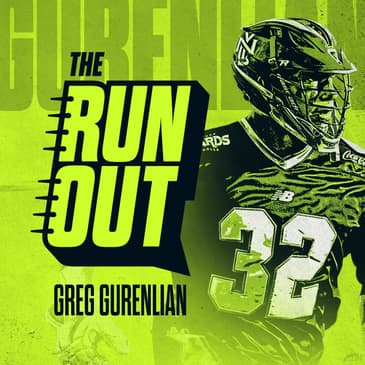
On this episode of The Run Out, I am joined by Greg "Beast" Gurenlian. He tells me about how his infamous nickname, "Beast", started as a joke. How an injury turned him into a league MVP, and what he learned in retirement that has stayed with him. Plus I get into a few of the headlines over the past couple weeks!
Welcome to The Run Out. A podcast covering all things lacrosse. Whether you are a seasoned player, a passionate fan, or just recently found the "fastest game on two feet", you are in the right spot.
Keep up with the conversation:
Twitter: https://www.twitter.com/runoutpod
Instagram: https://www.instagram.com/runoutpod
Email: runoutpod@gmail.com
Hosted on Acast. See acast.com/privacy for more information.
[00:00:08] Welcome, welcome, welcome to The Run Out. I am your host, Neil Barrett. We are finally back to normally scheduled programming here with The Run Out. Thank you to everyone who tuned in, listened, watched whatever Gold Rush during the championship series. I had so much fun creating that for you guys. Probably a little bit too much fun. I ultimately kind of burned myself out a little bit and had to take a full week off of pretty much
[00:00:38] everything other than my actual job. Just so much going on that I was like so tired and just worn out. I just had to take a week off. But we are finally, finally back with The Run Out. Thank you to Jackson and Casey for joining me. Like I said at the end of Gold Rush, I don't I don't know that I would have made it without them.
[00:01:06] It was a lot of work, a lot of late nights, a lot of early mornings to get that put out. I don't think I mentioned this beforehand. I may have but I don't think I did. I listened to a companion podcast during the World Cup a couple of years ago and I loved it. I had so much fun with it. And I thought it would be a really cool idea for the PLL championship series because it is this this week long.
[00:01:36] kind of event where everyone's kind of a little bit of event where everyone's kind of focused in on it. And there are games every day. So it's really easy to drop a new podcast every single day. And like I said, I had a lot of fun, but it was a lot of work.
[00:01:48] And if I end up doing it again next year, I have some other ideas on how it can be better, more enjoyable for you guys. Hopefully a little less work on my part, but was still a blast. So again, thank you to anyone who tuned in. You can still catch the episodes wherever you are listening or watching this at.
[00:02:11] So, you know, it's probably not as fun to listen to it after the fact, but it is still available if you would like to. Now, normally I would roll right into an interview here on this episode. We do have Greg Grinlian and I usually like for the episode to be the interview.
[00:02:32] And that is at least partially why I don't have guests every week so that an interview episode can be an interview episode and talking about the game or whatever else is going on can be that episode. And you guys aren't stuck listening to both for two hours every week. Some of you may really enjoy that.
[00:02:55] I know that even I don't always love to listen to two hour and a half, two hour, two and a half, three hour podcasts all the time. So I want to provide you guys with as much value as I can in a somewhat, you know, consumable size more regularly.
[00:03:17] But since I have taken a couple weeks off, there has been a lot happening in the world of lacrosse that we haven't covered. So before we get to Greg, let's get into it. After a weekend like the one we just had, it's hard to even know where to start. So I am going to start with the game that we knew was going to be a good one coming into the weekend.
[00:03:45] And that is with UNC beating Johns Hopkins at Homewood Field 13 to 12. The headline of this game is probably Dom Petromala scoring six goals in his dad's first game back at Homewood Field since stepping down as the Jays head coach in 2020. And Dom was absolutely on fire in this game.
[00:04:10] I'm sure you guys have seen a lot of the clips, especially that one where he gets fed and kind of all in one motion. There's no catch or cradle or or anything. He just kind of like catches it wound up and shoots all at the same time hit the top corner. Absolutely drilled that thing. I think you could have had Tillman Johnson, Jesse Schwartzman and Kyle Burnlore all in goal at the same time. And it still wouldn't have been saved.
[00:04:38] He was absolutely lighting it up. And he and Owen Duffy combined for 10 of the Tar Heels 13 goals. And probably an even more crazy number, as crazy as that number is, is that they had 31 of UNC's 40 shots. So that is just a crazy statistic for two guys on this offense.
[00:05:06] As for the game, UNC jumped out and scored the first three goals all in the first two minutes of the game and ran out to a 6-2 lead by the middle of the second quarter. Hopkins was able to kind of claw back into this game and even took a lead 11-10 early in the fourth quarter before Carolina scored three goals in 90 seconds to kind of seal the win in the end.
[00:05:36] Michael Gianfranco, the UNC grad transfer from Princeton, started hot with three early saves, but only made four the rest of the game and really struggled to hold off the second half run from Hopkins. If I'm Hopkins, I feel encouraged by the fact that we didn't have our best day.
[00:05:59] We got off to a super slow start and still were able to climb back into the game and even take the lead at one point in the fourth quarter. And I would think that, you know, on another day with a better start and, you know, just a few tweaks, we could probably win that game.
[00:06:19] However, the flip side of that is obviously that I would be concerned that we climbed all the way back into the game, again, taking the lead in the fourth quarter and couldn't finish them off. I would also be worried that Russell Melendez was the only consistent threat in this game. And without his individual brilliance, this game might not have even been close. He finished with five goals and two assists.
[00:06:48] And, you know, even if he has slightly more pedestrian numbers, you know, this, this isn't, this isn't much of a game. So I would be kind of keying in on those, those aspects and looking at trying to get the rest of that offense clicking the way that they have been earlier in the season. On the other side, if I'm Carolina, I'm stoked to see us jump all over a top 10 team away from home. The way they started that game, you know, they were up for it.
[00:07:17] And that is a very encouraging sign if I'm Carolina. And even though, you know, Carolina struggled defensively at times in this game, they ultimately did enough to see it through and grab a big out of conference win away from home against a very good Hopkins team.
[00:07:38] That being said, I would be worried that the defense and your much hyped grad transfer goalie and how they let Hopkins back into this game. That's obviously a problem that's going to need to be addressed. Jumping out to that six to lead early in the game just for Hopkins to claw their way back into it, you know, is probably a lot about letting letting your foot off the gas a bit.
[00:08:07] But, you know, I'd want to see my defense hold off that run. Not that they can't get one or two back, but again, to come back and take the lead 11-10 in a 13-goal game could easily have gone the other way.
[00:08:24] I would also be worried about what happens when you play some of the better defensive teams that can at least somewhat hold Dom and Owen Duffy in check and your ability or inability to get production from other guys on that offense.
[00:08:44] You know, like I said, for Russell Melendez having, you know, a slightly more pedestrian number, this game isn't really close. The same goes for this Carolina offense and Dom Petromala and Owen Duffy. If instead of accounting for 10 goals, they account for six, you know, both of them have a hat trick. That's a that's still a pretty solid day.
[00:09:10] But six goals instead of 10 out of them turns this from a a one goal win to a three goal loss. So I'd be a little bit worried about what happens when a team can hold them against somewhat in check in check by their standards and where you're going to get offensive production from other guys. It would be one thing if those guys, you know, had shots today and didn't score.
[00:09:37] But like I said earlier, the rest of the team combined for nine shots in the entire game, nine shots compared to 31. Like there's clearly a huge imbalance in their offense. And I would be worried if I was a Carolina coach about what happens when you play a defense that can, again, hold them in check at least to their standards.
[00:10:02] That being said, both of these teams are clearly top 10 teams, arguably probably even top five teams. And when they are putting it all together, they are capable of beating anybody in the country. I don't think there's any question about that. And I expect both to be involved in the discussion come May. Moving on, we have some insane upsets this past weekend.
[00:10:27] We will start in Columbus where Ohio State absolutely dismantled UVA 14 to five. Ohio State's defense was incredible in this game. They kept UVA scoreless for just over 35 minutes and held McCabe Millen scoreless, ending his 21 game point streak. McCabe Millen also left the game late in the fourth quarter after a big hit and did not return.
[00:10:56] As of recording this, there has been no word regarding his health or whether or not he'll be back. Hopefully, it's nothing too serious and he can get back on the field. UVA definitely needs him on the field. But all that to say, Ohio State absolutely smoked UVA. Nothing worked for UVA. That defense was just absolutely rock solid.
[00:11:25] A couple weeks ago, the last time we did a runout, we talked about how, at least as far as the internet lacrosse community is concerned, the two coaches most on the hot seat, one being Joe Bresci with UNC and the other being Nick Myers at Ohio State, had huge statement wins this week with Ohio State beating UVA and UNC beating Hopkins.
[00:11:51] So, obviously, I think you'd have a tough argument at this point to say that they are still on the hot seat. Though, at least as far as my comment section is concerned, neither of these are any more safe than they were a couple of weeks ago. So, we will definitely keep our eyes on that.
[00:12:15] The other big upset of the weekend was Harvard going into the Dome, beating Syracuse 15-14 for their first ever win against Syracuse. The story for me in this game was how Harvard got production from almost everyone in their offense. They had eight goal scorers, five of which scored multiple goals. And even with Tawaraton hopeful Sam King being fairly quiet,
[00:12:44] they put up 15 goals. That is kind of the opposite of what we saw from UNC's performance, where they had two guys that just kind of dominated everything, and no one else really did much of anything. Harvard had such a balanced and complete offense. I think that was a big part of how they were able to run out with a win, is that it was really hard to key on anybody,
[00:13:11] because everybody was doing what they were supposed to be doing. Personally, I think that Cuse is still fine. They got punched in the mouth. It happens. It's still early. They will recover from this. They will get better from this. You know, Duke has made an entire lifetime career out of early February losses, using those as growing experiences, learning experiences.
[00:13:39] The old adage that you learn more in a loss than you do in a win, and pushing on. Syracuse is still one of the better teams in the country, still probably a top 10. And like I said, for Hopkins in Carolina, I expect Cuse to be involved come May. A couple of quick hits from the weekend in college lacrosse. Putting on my best Denny Green voice, Cornell is who we thought they were,
[00:14:06] beating number 14 Denver 15 to 5. Presumptive number one pick in the PLL draft. CJ Kirst had six goals and two assists. Once again, proving that he is also who we thought he was. Just an incredible player who is, again, likely to go number one. Cornell is another one that I think is probably there come Memorial Day weekend,
[00:14:34] but we will see as they go on. Heading down to Durham, Andrew McAdory asks for the real Slim Shady to please stand up as he scored the last three goals of the game to literally drag Duke to an overtime victory over Michigan. That game was tense and tight and fun, but both teams probably need to work on some offensive scoring.
[00:15:03] If I was a Duke head coach, I would have Andrew McAdory playing at attack and everything would go through him. He doesn't necessarily have to be the guy scoring or assisting, but he is getting a touch on every single offensive possession the way that Brennan O'Neill should have, the way that Michael Sauer should have, the way that Matt Donowski did back in the day. I don't think there's any question that Andrew McAdory is that dude.
[00:15:33] And the last little bit of NCAA news for me personally, having worked at High Point University, doing lacrosse broadcasts, having attended practices at High Point under John Torpy, I was very excited to see Coach Torpy get his first win at Brown with a 7-6 victory over Providence. John Torpy is a great coach.
[00:16:00] I am really excited to see what he can accomplish with this Brown team over the next couple of years and wish him all the best. Moving over to the NLL, there was some great action over the last couple of weeks. Specifically, there were two incredible games between the San Diego Seals and the Buffalo Bandits. In the first game,
[00:16:27] San Diego put a stop to Buffalo's undefeated run before the Bandits got them back this past weekend. Both games were, again, very close affairs. One goal, I believe in both games, it was a one goal victory by San Diego originally and then Buffalo in the second game. Super fun games. I hope that we get to see that matchup in the playoffs, but San Diego is going to have to make some moves as they are currently sitting in the bottom half
[00:16:56] of the NLL table. Hopefully, again, they can get a couple more wins and we can see this matchup in the playoffs at some point because these two teams are just so well matched up against each other and all of the games are super fun to watch. Elsewhere in the NLL, the surprise of the season continues to be the Saskatchewan Rush who are sitting just behind the Buffalo Bandits in the NLL table at 9-2.
[00:17:25] That sets up an incredibly enticing one versus two matchup this weekend as the Bandits head to Saskatchewan to take on the Rush in a must-see game. I, for one, am going to do everything I can to sit down and watch that game Saturday night because it is going to be an absolutely incredible game and I am really looking forward
[00:17:53] to trying to get back into watching the NLL now that we have moved past the championship series. And the last little bit of NLL news is just a fun one for me as Michael Sowers made his debut for the Philadelphia Wings a couple of weeks ago scoring three goals and an assist in two games before being placed on IR last week with an undisclosed injury and no announced timetable for return.
[00:18:22] We will see what happens with that and his injury. I hope it's nothing too serious and he can get back on the floor sooner than later. But as a Duke guy, I will at least have those two games. Him and Brennan O'Neill on the floor at the same time together was such a fun experience. Again, for me as a Duke fan and I know I mentioned it before we took the break for the championship series.
[00:18:50] The Wings have definitely done everything they can to try and make me a fan and I still really, really am considering buying a Michael Sowers Wings jersey. I might just have to make it happen especially if I can find one of those those retro night jerseys that were so cool. I know he didn't play in one but those jerseys are amazing and if I can get a Sowers one I really might have to make that happen for sure.
[00:19:20] Okay, I think we hit most of the major highlights going on in the lacrosse world. Now that the runout is back we will dive into the NCAA and NLL seasons with a little more consistency and we won't have to do this kind of thing but for now let's get in to Greg Grinlian. I don't really need to do an introduction for Greg Grinlian. He is one of the best face-off athletes to ever play the game.
[00:19:51] He was a standout player for Penn State graduating with the most face-off wins in program history before being drafted into the MLL by the Rochester Rattlers and over the course of his 14-year MLL career he became the most dominant face-off athlete in the league culminating in 2015 with his MVP award as he led the Lizards to the MLL championship.
[00:20:20] He is also the U.S. record holder for face-off percentage at an international competition where he won 81% of his face-offs in the 2018 FIL World Championships in Netanya, Israel. That is just an unreal number. I don't care who you're going against. 81% over the course of an entire tournament is insane. He has also revolutionized the face-off position
[00:20:50] through his creation of the Face-Off Academy. We don't talk about it as much as I had planned to. We got cut a little short because we both kind of like to talk. So hopefully we can get him back and talk more about the Face-Off Academy. But Face-Off Academy is the program if you're a face-off athlete. So if you are a face-off athlete, the parent of a face-off athlete, or even just a coach
[00:21:17] looking to either improve your instruction or to have your players be instructed, check them out. You will not be disappointed. I know that they can even come to you in some cases. So again, definitely check that out. You will not be disappointed. I had a lot of fun talking to Greg while we both look very different. And you'll see that when we're side by side, we are both kinesiology nerds.
[00:21:46] So hopefully you guys will enjoy this conversation with Greg and it doesn't end up getting too nerdy for y'all. So I am here with Greg Grinlian. Greg, thank you for joining us today. Yeah, my pleasure, man. So first things first, you are a Philly guy, right? From Springfield for anyone who doesn't know
[00:22:16] that's just outside of a Philly suburb, we'd call it, I guess. Yeah, Delco. Delaware County. Yeah. You are the third person, third guest in a row from Philly. I don't know how that happened. It was not an intentional thing. In fact, the last time I recorded with someone, I hadn't even talked to you about coming on. So I was realizing that today. And that's just funny how that works. I have no connection with Philly.
[00:22:45] I might be the first one that you have on that's not an Eagles fan, though. You are definitely the first one. What are you? Who's your team? It drives my family crazy. So I was much more into college football. I started watching every Penn State football game from the time I was like five years old. Ray Lewis. I loved Ray Lewis. And I hated how Eagles fans treated the team. I thought when Eagles, like I didn't play football, but even I knew that things that are said
[00:23:15] by Eagles fans make no sense. And I gravitated towards the Browns moving to Baltimore and drafting Ray Lewis. And I was like, oh, okay. So I started cheering for them. And then as Eagles fans pissed me off more over the years, the way they treated Donovan McNabb all those years. Every time Kansas City wins a Super Bowl, I text all my friends from Philly. I go, hey, remember when Andy couldn't win the big one? So I'm not an Eagles fan. It's hilarious. My oldest son is a huge Eagles fan because he loves Saquon.
[00:23:46] But yeah, I'm actually a Ravens fan. So I'm a big Ravens fan. Interesting. I think now that you say that, I think I did know that from seeing your interactions on social media and is partially why I didn't know until I was doing research for this interview that I was like, oh, Philly guy. Oh, okay. Interesting. One of the things that I learned in setting this up was that,
[00:24:14] so I had a bit of a dark period in the game of lacrosse. I started playing early 2000s, 2001, I believe. And then I joined the military and I was out of the game for a while. I was stationed far away and I just, I might watch the national championship, but that was kind of the extent of it. And so I missed a lot of your early career. And the first kind of introduction to you, you were already playing for the Lizards. And all I knew was
[00:24:44] this guy called Beast who is, you know, this big hulking character who's a face-off guy does this very physical kind of activity and in my brain, Beast, this, like who you were as a Lizards player just meshed. And I learned in setting this up that that is not where that nickname comes from. No. No, as much as people wish it was because I had plenty of people who were like,
[00:25:12] oh, he thinks he's so big and tough, calls himself Beast. No, I got called that as a joke because I started playing lacrosse late and all I did was try to hit everybody because I couldn't catch and throw. And a lot of the older guys would yell Beast during the JV games. And then one of my best friends, George, actually started calling me Greg Beast and it caught on. So, yeah, everywhere I go, everyone's like, oh, yeah. But Beast to me is like an endearing name. Like if I know you really well, you probably call me Beast. Most of the friends that I met in college
[00:25:42] probably still didn't even know my first name by the time I graduated because that's all I was called for my entire four years. So it's actually weird when someone calls me Greg. I still, I'm so used to Beast that that's, that's so weird that we call Greg. Interesting. So when, when did you start playing? You said late, later in high school, right? Yeah, I started playing my freshman year and I tell people all the time I was going to quit because it was really, really hard. I played at Springfield High School, which is one of the best public schools in the country
[00:26:11] for lacrosse. And we had like a storied history, but everybody in school who wore the lacrosse shorts and, and, you know, was considered a cool kid. So I wanted to be one of the cool kids. Plus baseball was boring me. And I tried and I almost quit. And then one of my assistant coaches just kind of like gave me a pep talk one day and it wasn't for Rick Johnson and I never would have kept playing. I was fully intending on telling them that I was quitting that day and he just grabbed me and talked to me for a second and changed the trajectory of my entire life. So yeah,
[00:26:41] I started playing late, man. And that's why I tell guys it's never too late to play. One of the things I love about lacrosse is, you know, I loved basketball. I loved wrestling. I loved soccer. But lacrosse is one of those games where you don't have to be a natural physical freak to be able to play at a really high level, right? If you're a 6'11 person in this country, you can play, you can play basketball. You can, you don't even have to know how to walk and chew gum, but you can just be a guy on the sideline and play basketball.
[00:27:10] If you're a big, imposing, super fast, physical freak, you can play football. Lacrosse, I had an appreciation because I was a very athletic kid. I was used to things coming naturally to me. Lacrosse didn't. I had to earn that. I had to earn the time with the stick. And that's where I appreciated it. And now when I'm coaching, like I coach my son's second grade team, and I tell all these kids as they're getting into it, I'm like, look, as long as you get good at catching and throwing with this, you can be as good as you want.
[00:27:39] But that's why I love lacrosse. There's so many shapes and sizes and specialties. And, you know, you could just be a crease attackman or you could just be a face-off guy or a goalie. So that's why I love lacrosse. Yeah, I am right there with you. It's one of my favorite parts because I was very undersized, especially, I'm kind of on the low end of average now, but I was especially undersized back in high school. And I don't know if you saw, I think it was yesterday, I saw Mark Millen
[00:28:09] tweet out that, you know, if he was building his like prototypical attackman, it would look a lot like Pat Spencer. And he talked about, you know, his size and his strength. And there's obviously an element that I think is kind of immutable in lacrosse. And that's Pat Spencer's IQ. You kind of can't get away from that. But I kind of bumped against the idea of his size and length being such an advantage because, you know, I personally have always really
[00:28:38] enjoyed smaller, quicker, especially as an attackman. I was mostly an attackman. I always enjoyed those guys. I gravitated towards those guys. And it always meant a lot to me to see Jordan Wolfe and, you know, Billy Bitters and smaller guys come in and be just as good. So, that's always been one of my favorite parts as well. So,
[00:29:07] you start playing as a freshman. How quickly did it become apparent that this was going to be something that you could do at the next level, at the college level? That's where this whole generation is weird for me because I never thought about playing in college. It wasn't my number one. Like, you know, we meet fifth graders now with the parents like, how does he get recruited? And like, for me, it was like, your goal
[00:29:37] was to play varsity. And then after playing varsity, your goal was to win a state championship. Like, there wasn't really any thought after that. So, for me, it was like, once the switch turned, I got back in my parents' car and I decided that Coach Johnson had just said these words to me that I need, that he believed in me. My goal then was, it was actually kind of out of spite. All the guys who ragged on me, all the guys who made fun of me, my goal was to take their job the next year. I was like, I want to play varsity next year, I'm going to start over some of these guys.
[00:30:07] And I was totally that kid at the party on a Friday night with his lacrosse stick. I couldn't get it out of my hand. I was hitting the wall, driving my dad nuts, destroying the stucco, breaking the fences in the backyard. My dad got me a lacrosse net and totaled his garden fence. Could not stop with the stick in my hand because I wanted to be able to play. Now, I got lucky because on JV, Chris Britton, who was a face-off legend at Springfield, taught me how to face off real quick. And I had a knack for it because I was a wrestler.
[00:30:37] And wrestling is one of the most applicable skills you can have, at least back then, to facing off. And I just had a natural quick response to the whistle. I was good at it. It got me on the field my sophomore year. And then my junior year, I was, you know, expected to be like a second or third line middie on varsity. And our starter, who ended up playing at UPenn, he got hurt. So the second game of the season, I get thrown in to take face-offs and I go like nine for ten. And then I
[00:31:07] kept taking face-offs. And I was like just awesome at it. And it was a much less refined skill than it is now, but it was just, I could clamp faster you and pull the ball out. And then once I got the ball on my stick, I could run past you and create an offense immediately. So then I was averaging like two or three points a game. And then I got bumped off to first line mid. So now I'm playing first line mid, I'm facing off, I'm playing man down, I'm not coming off the field. And then that following year after my junior year, back then, that's when your recruiting started. And there
[00:31:37] was really champ camp, top 205, and that was pretty much it. And if you made the all-star game at those events, you were going and made the all-star game and did really well at both of those events. And I got my first letter from Towson, and then I got a letter from Penn State, and I remember telling my dad, I'm like, I think I can play in college. And I just remember us jumping up and down, like, Lars Tiffany from Penn State, it's a ladder. And of course,
[00:32:07] I went on my recruiting visits, but I was always a Penn Stater, my whole family went to Penn State. So I took a very unorthodox way of going to play college lacrosse. I knew nothing about Penn State lacrosse. I didn't know if they were good. I didn't know really anybody on the team. I went to Penn State's overnight lacrosse camp for three straight summers just because I wanted to be up there and get to know the coaches. And then when I accepted the offer, it was like the first day I got to
[00:32:36] Penn State, that was my dream. My whole dream was to go to Penn State one day. And I was like, I made it. And I was like, now I got to figure out if they're good at lacrosse. I have no idea, but I knew they had an amazing kinesiology program. I wanted to be a phys ed major and I wanted to go to Penn State. So it was, you know, I started late in high school. I went to public school. I didn't go to a traditional hotbed. I didn't pick a traditional hotbed in college. I did everything wrong and backwards as a quote unquote professional lacrosse player. And I didn't realize I was going to play lacrosse
[00:33:13] you mentioned that you are a Penn State lifer. You have always been a Penn State fan. And I've heard you say that it was never really in question, you know, Penn State was it. I wonder kind of two things. One, what other schools were kind of in and two, what's the closest you got to ever, even if it was just half a second of I could see myself here, what's the closest you got to any of the others?
[00:33:43] So, Talvin was, I knew they had a good phys ed program. So, I wanted to go take a look at Talzin. They had been in the final four that exact year for the first time or whatever Coach Seaman was there led them to a final four and we had had a guy Chris Lampano who went there from Springfield. So, I was like, you know what, I'll go check out Talzin. Coach Calhoun, who was the head coach at Butler, was my coach at top 205. We got along really well.
[00:34:13] I really liked the guy. They offered me a full ride, so I went out there and took a look. and then my other trip was to Loyola and I went out down there because my dad, my parents completely stayed out of it. They were like, this is your trip and neither of my parents went to college. Everybody on my dad's side went to Penn State. He just was a union electrician. He never went to college. So, he's like, look, I can't really offer you any advice in this, but you got to like, so I had spreadsheets. I had lists. I was ranking the teams because I
[00:34:45] had five official visits before you chose. I had one more visit. That was the year Cottle left Loyola and went to Maryland. He recruited me at Loyola. Then he started recruiting me late at Maryland. I knew they had a good kinesiology program. I knew they were good at lacrosse. I just didn't know that much about them. He
[00:35:15] was like, look, there's another guy. If we got to know by Friday, if you're going to come or not, we might have to go with the other guy. I remember getting off the phone and panicking to my dad. They're going to go with somebody else. If I go to Maryland, how bad do you want to go to Penn State? I don't want to screw this up. There's your decision. I called. I went to cancel the Maryland
[00:35:46] trip. That wised me now. I'm giving advice to these kids that I coach. When they're going through this stuff, no one was there to walk me through this. It was close. If I went on my Maryland trip, they had offered me, there's a good chance I would have had a tough decision. Maryland is similar to Penn State. You
[00:36:22] go to Penn State. You are a four-year letterman. You are a co-captain your senior year. You finished second and ground balls. At the time, first and face off wins. What? Not what? I kinesiology was a big part of your decision making. I'm also a kinesiology major. That's
[00:36:52] what my degree is in. What drew you to kinesiology? You said you knew that was part of your thing. I got into it late. I went back to school after the Air Force and all this stuff. What drew you to it already? That was a big part of your decision making. I had two really cool gym teachers when I was in Springfield.
[00:37:22] I thought they had the coolest job on earth. I was like, this is what I want to do. I want to teach phys ed because I love the human body. I love learning about it. I was one of the few kids when we were going through health class. I'm asking questions. I'm asking I'm a gym in our town called the health plex. It was a nice gym. My family couldn't afford to go there. I got a job
[00:37:52] where I agreed to wipe all the machines down after school. Because I got a free membership. I started to understand and have an appreciation for the human body. My parents were pretty strict. My parents were on top of me. You're first born. You have your parents, teachers, coaches, older kids, everybody in your life telling you what to do. You have very little autonomy. I started
[00:38:22] to understand I had a full control over what I did with my body. If I wanted it to be bigger, I could make it bigger. I fell in love with that kind of control. It's like an adorable version of you're in prison. I'm going to lock myself out of this situation and I'm going to work out every day to harden my body. That's the way I looked at it. I remember my dad redid our roof and I was shoveling shingles
[00:38:51] all summer and I started working out that summer. I came back my freshman year in high school and I was like, whoa, dude, you got a lot bigger. That's where the light bulb hit. If I could go and do a phys ed teacher and be in the gym all the time and I work out, this is the best thing ever. Penn State had the best phys ed program in the country. That was my goal. After two months of phys ed at Penn State, I was
[00:39:21] like, whoa, this is so much harder and so much more involved and competitive than I thought it was. Then I remember going to our counselor and she was like, look, you just have to understand that you go through all this and you get into the College of Health and Human Development and you become a phys ed teacher. There's a very small chance you're going to get a nice, cushy gym teacher job like the one you saw in the suburbs of Philadelphia. It's a very
[00:39:51] good chance you end up somewhere in an urban place where you're throwing a basketball over a fence. You're just kind of to get to know our strength coach Brad Pantel at Penn State. He took me under his wing. He was literally like a big
[00:40:38] so cool to me. That's where I switched from phys ed to movement science. Of course that was 10 page lab papers but it was intrinsic. I would gladly take another biomechanics course over Stat 200. I fell in love with it. That's where my life changed. I was to take my life into that strength training direction. Biomechanics was one of my all
[00:41:08] time favorite things to learn. Another kinesiology nerd question here. Obviously the answer is everything. What did kinesiology teach you tangibly that you were able to apply to lacrosse facing offer or lacrosse more generally other than everything? Aside from the obvious stuff of being bigger, faster, stronger, more flexible, more mobile. What
[00:41:38] I learned, when I blew my knee out in 2011, that was the first moment because I was also working as a full-time strength coach in and I sat on the
[00:42:08] couch that summer and I remember being so down on myself because I was like I have this gift and this talent to do this thing and I'm a professional athlete but I look at it as something I do on weekends and I haven't been really harnessing what I know so that summer when I blew my knee out I remember I was watching the women's world cup that summer and I took the face off position and I applied biomechanics to it now if anybody wants to google on youtube try to find any
[00:42:38] face off videos before 2012 on youtube most of the people have taken them down now because they're embarrassed of themselves which they should be but almost every video was just a guy teaching cheating or this is what works for me but there was no system there was no order of operations physically to teaching a position that has a constant unlike anything else in the cross the ball is always in the same spot it's always a right handed face off there's always supposed to be
[00:43:07] a cadence and an order to it so you can actually apply the same biomechanics that you would to a power clean to the face off so I wrote an entire face off training system Chris Madison and Jerry were like yeah let's go do face off clinics together we applied that and I applied it to my own training so I rehabbed my knee applied that own training to me I came back from my knee injury and in 2012 by far personal records in every single stat in face offs every kid we were teaching was going out
[00:43:49] lacrosse coach it's like well actually I built pretty much an entire industry off of the fact that I just applied angles to what we do so that was the first time anyone done that and that's why it's successful because it's so consistent if I were to teach you face offs you show me three clips of you taking a face off I could show you
[00:44:21] thought about the biomechanics of that and how like you said it can be kind of a power clean that makes so much sense so at what point sort of like with high school at what point in your state career did the potential to play lacrosse professionally start to enter your mind it doesn't sound like you're a guy who tries to be that far forward that far into the future of like this is what I'm going to be doing but
[00:44:51] you know at what point did that become kind of a reality for you yeah by the time I finished my sophomore year I was fully dead set on being a professional collegiate strength coach interning with Brad in fact when I graduated immediately hired me he moved from all these other sports to just men's women's basketball at Penn State he took me with him and I was his assistant at Penn State immediately fall after I graduated and my full intention was to get my master's
[00:45:20] in human performance and be a head collegiate strength coach one day that was my full goal I wanted to do that and my junior year I was third in the country in face off percentage it was the first year where guy Van Arsdale came over and he was
[00:45:53] does it wreaks havoc with your game planning and your ability to visualize guy took that off the table was like go kick ass for us so that was
[00:46:23] a letter from the MLL said you're invited to this year's combine and draft and I was like wow I never in a billion years thought that would be something that I'd be doing was playing professional lacrosse so yeah I mean that's when I realized this is a possibility and then I went out to the draft combine they used to do a legit combine you'd go out there after your season was over you would interview with every
[00:46:53] general manager and sometimes owners and the head coaches of each MLL team back then there were 10 teams and I hit it off really well with a assistant at Penn State used to be the head coach so he put in a really good word for me with B.J. O'Hara and they drafted me I think I
[00:47:42] struck me as one of the most 2005 ways to handle the face off guy at that time was like yeah y'all go do what you do and we'll be over here like that just that cracked me up but like you said you were drafted in the third round by the Rochester Rattlers in 2006 and bounced around a little bit two years here two years there I was wondering in that time what was
[00:48:12] that like was there moments of self doubt when you're bouncing around like you said you had wanted to be this kind of full strength guy and professional lacrosse hadn't really entered your mind and you you're trying to do that on what was those first few years before you settled in New York like
[00:48:42] for you yeah I think everybody goes through this right regardless of how good you think you are you know I had no idea how good I in so I leave high school I wasn't a high school American I was an all state player I was an high school American
[00:49:11] in fact I went to the U19 tryouts they sent me to the USA U19 tryouts and I didn't know anybody I didn't know who was good I here and guys are shooting and ripping shots and every single one is kind of pinging off the goal post and hitting
[00:49:41] corners and you're like wow I'm this skinny 18 year old kid who I thought I was good I think I'm athletic and then you play fall ball and you play fall ball tournaments and you play scrimmages and you're like yeah I'm good enough to do this yeah I can definitely do this and you get to spring where you've put on some weight like when I got to Penn state I was about 170 they put me on 10,000 calorie a day diet by the time I graduated I
[00:50:11] was a little over 210 so I was lifting I was training and all of a sudden my freshman year comes and I start playing in some of these games and I'm doing well I'm winning my face offs I'm doing well on riding clears and then you're like yeah I absolutely belong here now it's time to soft guy Pete Blahakis in two games playing
[00:50:41] against him my freshman and sophomore year in college I was probably a combined five for 30 he absolutely destroyed me when I played him so I'm sitting here like this guy again and then I score four seconds into my career and I end up with four points at night or three points at night and I go back in the locker room because dock lock and two point
[00:51:11] arc and the field feels small and the lights are on you and there's fans in the stands like I felt like I did like a four by 100 meter sprint I was I had this massive chip on my shoulder
[00:51:41] no one knew who I was I know I wasn't supposed to be there I'm looking over here there's Gary gate looking over here is Kevin can see Brody Merrill on my team I'm like John Grant Jr. on my tab who am I and yeah then I played for Rochester that year I went a little over 50% I thought it was a great first year then Alex Smith came out who was a really good face off guy in college he got they drafted him and then called me and we're like look you know we
[00:52:31] dragons traded for me and I went out to San Francisco and immediately had a phenomenal like I was playing great with them and then in 2008 we came out to Long Island played against people Hocus still remember to this day my now wife was in the stands for one of the first times she was seen me the
[00:53:01] next year San Francisco closed because there was a massive recession if you remember so all those West Coast teams kind of closed and then they took the entire league and they reordered everybody and they said okay we're going to reorder you based on geography where you live but I I was in the lizards so I was like I was I in Canada and I was like Toronto doesn't a strength
[00:53:31] training business right here I can't fly across the country every single weekend anymore like I did with San Fran I need to be closer to home I know Boston was trying to grab me and then Chicago was so pissed at me they let me sit on the shelf for a full year so all of 2009 I didn't play they wouldn't trade me they wouldn't talk to anybody about me they just wanted to screw me over so then I became a waiver free agent in 2010 and they Jim you remembered that game against the Lizards and he said he grabbed me real quick off waivers
[00:54:01] I but the Lizards that changed my life that fan base Jim Mule Joe Spelina those guys my whole life changed after that happened from what I believe I've read you
[00:54:41] being local and being that full time played a part in and going from that that dude who was very capable very good but was getting bounced around to being the beast that you became in New York the key to it all was my knee injury because I was still playing like an athlete who could face off when I actually studied the system and I started training
[00:55:11] like a face off man who was athletic instead that's where it all changed I came back after my knee injury because the first four years of my career if you look back statistically I was almost averaging a point again my whole thing was like go forward go forward go forward and it was like okay but what if you didn't just do that what if you broke this thing down and that's what I did I charted my exits I created an entire system and that's where like teaching face-offs every day so my day was wake up at 445 in the morning train my
[00:55:40] clients until 2 lift roll out stretch do all that stuff train my clients in the afternoon then 2 or 3 times a week I would then hop in my car and I would go to Randalls Island or Long Island or
[00:56:42] it that. And I was refining myself as I was coaching, it got to be too much in around 2012 or 13. It was just too much. And yeah, 2014, actually, that's when I sold, it was called Brolic Strength, my training business, I sold it, because I was like, this FOA thing is taking off, I'm traveling every weekend, and I'm working three or four nights a week. It's just too much for me to do during the day to train as well. So that's when I sold it. And I was full time. But that was really the
[00:57:12] catalyst was my knee injury. And I tell this is what I use as an example all the time for kids who are really down and dejected when they get hurt. I'm like, listen, man, give yourself 24 hours to feel so much pain and feel terrible for yourself. But then flip that switch and go from feeling sorry for yourself and being emotional to being analytical. How are you going to attack this now? There's good to come from this. And my life would never have been on the trajectory that it ended up on if I
[00:57:37] had it blow maybe out in 2011. And that leads to 2015, you set the MLL record for ground balls in a season, face-off wins in a season, and highest face-off percentage in a season. You were named the MLL MVP and led the Lizards to an MLL championship, which is a lot to do in a single
[00:57:58] season. I would say arguably that, you know, I know Trevor's had a pretty good season and Jeff T this year was pretty incredible, but that might just be the best season all around in the history
[00:58:18] of the game. So that's, that's incredible. Um, uh, then you retired in, in 2017. And I heard, I heard you say that that was, that was the timing for that was primarily so that you could rest and push for the 2018 world championships with team USA. Right. Yeah. Yeah. 2014 that failure. Cause we, we lost. So I had to get a quarter zone shot just to play in the world games. Cause I dropped out originally. Cause my knee, my, my,
[00:58:47] my shoulder was shredded. Uh, so I dropped out originally. Then the team USA came back and was like, look, if we bring you and Chris on, would you be okay with that? I'm like, yeah, I don't want to just be the only face-off guy in the roster, but then all of a sudden my shoulder is falling out of its socket in the gold medal game. And then I can't face off. And Jeff Snyder just rides into the sunset with a gold medal. So they brought us both on. I got a quarter zone shot, played in the world games, set the USA record during those world games. Um, but we fell short.
[00:59:15] We lost, we lost in a gold medal game. And then a few weeks later, the lizards go out to Denver and we lose to the outlaws in the semifinals. And I just remember being, I, you know, I'm getting shoulder surgery in the fall. I'm so dejected, you know, I have lost, I've lost multiple championship weekends now in the MLL. I lost the only gold medal attempt I ever thought I'd get with team USA. I was just grief stricken. And I was really starting to think like, maybe this is me. Like maybe, maybe like, I remember when the, after Rochester traded me, like the next year,
[00:59:44] they won a championship and all this stuff is lingering in my head. Like, dude, maybe you're just the problem. Like maybe you're not a good teammate. Maybe no people don't want to be around you. Maybe you're just not good at as good as you think you are. And, um, I remember getting shoulder surgery. It got fixed. I come in in the spring and I just had a fire lit under my ass. And I just wanted to like, I came out of the season. And at that time too, the lizards, the MLL changed their face-off rules to model college across. So you've seen me on Twitter,
[01:00:13] uh, you know, just lambasting the PLL, the NCAA when they don't get the face-off rules, right? Because I lived the advantage of being a quality face-off man who doesn't cheat and having good officiating. It's a reason that 2015 year, it wasn't just winning face-offs. Like I'm out to retire people because when you can't grab the ball with your hand or use your elbow or roll into it early or crowd the ball, now it's just you and me on an Island, dude. And I'm going to kill you. Like,
[01:00:42] so that year was great. And it was fueled by 2014's letdown. And then after we lost the, the, um, then a couple of years later, we had our son. So Jax is born and my wife's like, look, man, like I've been a really good soldier about this for about 10 years, but like you're traveling three weekends a month in the off season for FOA. And now you're traveling every weekend in the summer. And I was like, all right. So I went out for one USA weekend. I thought it was my last one
[01:01:11] because Casey Powell was doing it too. I met Danowski. I met Amplo. I met Tierney and they were the new coaches. And I came back home and I told Jenny, I was like, I love these guys. Like, I really think that I can, I can win a gold medal and help this team. Cause I knew Trevor was coming up too. And I was like, if I can be on this team with Trevor, like it would be awesome because I've been the guy, he's the next guy. I can give him experience. He's got the youth and talent.
[01:01:39] And, um, so she's like, okay, but you can't do both. You got to pick, is it gonna be world games in 2018 or are you going to play professionally in 2018? But either way we agreed 2018 was gonna be it. So I picked the world games and I said, look, I'm going to just take a chance that I'll make that team and I'm just not going to play in 2018. Uh, and it worked out. So I, I just had to bet on myself on that one. So obviously you win that, you win that gold medal in, in, uh, Natanya and,
[01:02:07] um, I'm sure that was worth it in, in the end. Uh, and then, and then, and then at the world games, are you assuming you are, you are done playing lacrosse or do you already know? That the PLL is coming and are being, are, are being tempted back into it? Yeah. So it was kind of awkward because the lizards did an amazing job. They gave me incredible
[01:02:33] send off my last game. I'm fully retired. I'm like, okay, I'm going to win a world. And then I win the gold medal. I come home. I'm like, wow, my lacrosse career is over. That's wild. And it took me a while to like, even understand that. And at the time I knew about the PLL guys were talking about it out in Israel. And then I was helping them with their new face-off rules. So I was like going down a checklist with Tom Schreiber. I'm like, here's the things people complain about. Here's how we fixed them. It's going to be great. It's going to work out awesome.
[01:03:03] And then out of nowhere, he just asked me on the phone. He's like, do you want to play? And I was like, okay, two things. One, if you're actually going to do these rules, then I will play. Cause I'm jealous that these guys get to play with these rules. Cause these are the best face-off rules. I was like, secondly, you're going to have to at least pay me enough so that my wife doesn't divorce me the second I bring this up. So we agreed on it. And then
[01:03:27] we went forward with it and it happened really quick. And of course, you know, people got wind. People started hearing that I was going to play in PLL. The lizards call me, say, I can't believe you're doing this, blah, blah, blah. Make me feel bad about it. They're like, we'll offer you a hundred grand to come back and play at the lizards this year. And I was like, where was this money when I was a league MVP and I was getting paid 12 grand. And I was like, look, it's not about the
[01:03:54] money now. Like I, I thank you, but like, I'm doing this because I feel like this league is going to be the future of lacrosse. And I want to be part of that. But this is embarrassing because you were telling us for 10 years, I played professional lacrosse in the MLL for 11 seasons and the max contract never went above 16 grand. And now all of a sudden you're telling me there was a hundred grand under your sofa that you could pay me. So that's where it like really happened quick.
[01:04:23] And then I went with the PLL and of course, you know, they were saying, we'll pay a hundred grand this year. We'll pay X the second year. And I'm like, no, there's not going to be a year. There's not going to be a year or two. Trust me. You guys will hang on baby for one year, but this thing's going sideways very quick. So yeah, I, I, I came back to the PLL and I'm so glad I did. That was such a cool summer to experience. Um, I got to meet guys that I never got to play with. I got
[01:04:47] to play for coaches. I never got to play for, so it was pretty awesome. Um, I, I want to talk about those face-off rules because I, I think that 2019 was the best year of facing off. But before I get to that, uh, uh, an esiology nerd in me once is wondering what, what did you learn in that?
[01:05:12] Cause you know, you're training, you're prepping for Israel and thinking at it after when Israel's done, you're, you're done. And, and obviously there's a, there's a level of, of faith that you keep yourself in just kind of generally and year round, but you then have to switch suddenly from thinking that you're, you're done playing lacrosse forever to suddenly you have whatever it is, six,
[01:05:39] eight months to get back into kind of geek, you know, lacrosse playing shape. What did, what did you learn in that experience that, that you can use going forward? It's a phenomenal question. No one's actually ever asked me that. So I, so to this day now, I still train as if I'm going to play. I still break my, my, my, my year up into four Mesa cycles. I have a pre-season, in-season, post-season, off-season, and I still train that way because
[01:06:07] I know the day that I slow down, I'm going to get old. And my whole goal is to not feel like I'm ever old until I'm fucking old. Um, so I still train, but what I did was my, my limit was always injuries because my mistake that I've always made. And I'm trying to make sure kids don't make that mistake now is I was bullheaded early in my career where I thought more was more
[01:06:32] train as hard as you can every day, train, train. I get done a game the next day. I'm in there. I got to be in the squat rack the next day. I got, it's just a mental thing. I got to prove that this isn't getting to me, but I'm getting to my body and I'm breaking it down. And I was never able to replenish, but also on top of that is I played through so many injuries, right? So in 2008, I played with a fractured leg. I had a, I had a fractured fibula. I'm playing two games on it.
[01:07:00] Take a jump shot. It snaps completely. Now I'm going to cast for however many weeks. Um, I, I played through my, I blew my knee out. The doctor and the surgeon were like, you can't play for like 13 months. Like you need to prepare because you have a micro fracture that you need time for that to heal. First game, nine months later, right? I, I tear my labrum. I get labral surgery four months later. I'm playing. Um, I played all of 2016 with a fractured foot. Um, you know, it's like, it just,
[01:07:27] I'm always playing injured. And because of that, I felt like I was letting people down if I didn't, but you know, like I'm in pain all the time now and I'm constantly healing myself. Like my whole goal right now is I'm trying to heal my body after years and years of beating it to death. So when I retired, I still trained hard. The only difference was, is that I wasn't going out and playing and allowing myself to get hurt and then play through it. Right? Like I didn't learn any lessons. 2019,
[01:07:56] you look at my, my, my season with the Redwoods. I had one game under, under, under 50% on face-offs. And it's because I tore my hamstring three reps into our whip snakes game. And I decided to play with a torn hamstring. I was on one leg the whole game. And you know, it wasn't for that game. Actually, I would have led the face-off percentage. So I went like five for 30, but it's like,
[01:08:20] I don't know when to stop. And I think I, I knew that in myself at that point. So I didn't play. Um, but that healed me so much because Todd Giorgi who owns a strongman gym and Maronick trained me for the world games. I felt strong. I felt powerful. I felt physical. I was in phenomenal shape. And I also knew too, you know, I was like, I'm not jumping into a season. Like I'm 35 at the time. Now I'm
[01:08:48] jumping into, I got to go hard for 10 days. Like if this is, if my, if the wheels fall off, all good, I will just heal myself the rest of my life. But I was like, I can get through basically seven games of taking two on two off face-offs with Trevor and him and I were both good too. It was like, yo, you're on a roll. You take the rest of them. I'm on a roll. I'll take the rest of them. Um, so I was prepared for that. And that's how I trained. And I still like to this day,
[01:09:14] aside from being really sore for a couple of days after a game or two and my knee hurting, like I'm in shape, I'm ready to roll because I know that if I train any differently, or if I take my foot off the pedal, I'll get old real quick. So in 2019, you are forming, you are a part of forming those, those, uh, face-off rules. And like I said, 2019, the, the, that for me was the best face-off looking at college, looking at everything.
[01:09:44] You know, I, like I said, I've been around the game for, you know, 25 years now at this point, that was the best period of lacrosse facing off. Um, what, what I guess were some of your biggest pieces of advice for that? And then, and then I guess part two and the part that, that has frustrated me is why hasn't it been there since? And I know that's a frustration of yours as well.
[01:10:13] Be careful asking those questions, Neil, you get ostracized real quick. I think I'm already there. Um, so the, what I did was something groundbreaking that no one ever tried before. Um, I just went down and I made a list of things people didn't like about face-offs and I corrected them. Um, so something we just never had with rules committees and all this stuff is usually have a bunch of guys in a room who haven't faced off arguing about face-offs.
[01:10:40] Um, then they make a bunch of rules that they think will fix it, but because they haven't faced off, they don't understand all the loopholes and gray areas they left behind that then get exposed later. Then they try to convey those rules to a bunch of referees who've never faced off. And then it turns into a shit show. So in 2019, I went down a checklist. Okay. Let's see. Think people are upset about they're upset that there's lockups. That was the biggest thing. And I was like, I agree. My labrum has been torn 8 million times because our face-offs last a minute.
[01:11:10] Why do they last a minute? Well, it's because of knee down. No, it's not. We're supposed to be lined up like this top to stop, but the referees are letting us line up like this and the referees are putting the ball in the throat already. And the referees are letting us put our hands two fingers up on the plastic. So basically you're putting the ball in the strongest part of the plastic to start. We're going at the same time. And we basically have to saw one of our pinkies off in order to get a full clamp and pull the ball out. That's why.
[01:11:39] So I said, hands off the plastic. In fact, I had this little rubber gasket that I introduced to them. I actually introduced it. I don't know if people remember. I actually made a video about it. Oh, here you go. I made a video about it in 2015. My concept was you're not supposed to have your hand on a plastic. So I had this ring of tape at the end of the plastic of the head, put your hand right up against it. So now you're this far away
[01:12:06] from the ball at all times. And I'd put that video out there and I said, Hey, you know, I call this a power nub. It allows me to push my hand up against it. I won't slide my hand up on the plastic. You know, I'm not grabbing the ball. You know, I'm not crowding the line. And of course they never listened to me in the rules committee, but apparently they've watched my YouTube channel. So immediately a memo goes out that guys are not allowed to do that anymore. They're not allowed to put tape on their plastic. So I was like, okay. So I introduced that to Tom and I said, look,
[01:12:34] what if we have this little rubber gasket? Every face-off guy has a neon gas that we slide it right up against the plastic. Everyone has their hand there. So, you know, for a fact, every face-off guy is not going to be grabbing the ball with their hand. We didn't go with it. Okay. So instead let's line the ball that sticks up like this, let's put the ball at the shooting strings. And what we'll do is we'll draw two lines. The refs will put their foot on the line. We'll line up, ball will be at the top, down, set, back out, whistle. It'll be great. We'll move the wings in a yard or two on the
[01:13:03] side. I think we ended up with one yard on either side, which worked out great for PLL dimensions because the field's also 10 yards shorter. So now you have wings that are closer to you to incentivize you to get the ball out quick. All we need is the referees to make sure hands are off the plastic, physical set call, back out, blow the whistle. And this thing's going to be great. So then the season's about to start. And then we have all these weird little rules that were just thrown in there at the last second. Like the long poles and the wings are allowed to check your stick
[01:13:32] while you're engaged on a clamp. Okay. So now you're just asking for guys to get hurt. All right. So where's my extra incentive money to make sure that I can pay for my hospital bills? Because in the first game, I have guys ripping at my arms while I'm tangled in and they're on a lockup. Um, and then of course, you know, Maddie Palme, who I love Maddie to death and I would, I would save him in a, in a car crash in a second. Um, but him and I argued for 14 years about the
[01:13:58] face-off and he said, you know, I said, hands on the plastic are bad because it creates a lockup. Letting guys go on a swizzle call saying set whistle right away means no one ever has to get set. Guys roll into it. Everyone's cheating. And you know, I say if everyone's cheating, then it's even. Okay. Um, we will, I will die on the Hill that that's not right. And, uh, so we had 90% of the things right that year. Now in that year, if you look at it,
[01:14:23] Trevor led the league and face-off percentage by a little bit, but almost every starter in the league was within about 10% of each other. Face-offs were super even because the ball was lined up higher and the wings were closer, which meant that you could actually game plan for three on three face-offs. And, um, then I retired after 2019, the responsible teacher left the school.
[01:14:48] The principal doesn't care to check in on the classrooms and now all hell broke loose. And, um, no, look, I've, I've learned over the years now, you know, like I tried to call attention to it. I tried to help. I tried to say what I could, the more I pushed and tried to help, the more I got pushed out of the inner circle of friendships. Um, so now, like you said, you talked about Twitter the other day, like you're the last person I actually talked to on Twitter. I deleted Twitter,
[01:15:15] like this week. Um, I'm done. People don't want to be helped. So I'm not helping anymore. Now the NCAA has gone in this direction. Now the PL going in that direction that I don't even look at the face-offs anymore. The PL, they're shit show, but the NCAA is going this direction. Now they put the set call back in. I've talked to a lot of coaches that are like, they want to get it right now. Um, the hard thing with our, with our sport is that we change the rules so fast guys who don't
[01:15:41] understand the position, change it. Referees are either, they either want to get it right, but they can't keep up with the rules or they're just lazy and they don't care. When you come to a face-off Academy event, we vet our referees. We have the same refs almost every year. And if a ref is not up to snuff, he's gone. We bring another one in. I have a YouTube link video that I send to all referees. This is exactly how I want it done. We do stick checks. We do face-offs correctly.
[01:16:08] That's why kids love FOA events because they know it's going to be done right. It's a wild that a entire organization run by like two people can do it right. Yet these conglomerates that are on ESPN don't have the time to get it right. They don't care. Uh, and the only people who ever suffer are, are the, are the players. So yeah, I mean, 2019 was awesome. I really thought we were onto something, dude. I really thought we were onto something. Um, and then, you know, and then just didn't turn
[01:16:34] out that way. Yeah, no, I agree. 2019 was awesome. And I, I loved the face-off was still very important and the, and the guys who were good were still good, but it was not such a game changing thing to have a Trevor Babte, you know, you could, you could overcome that a lot more easily. And weirdly, I feel like the, the PLL specifically when they, when they kind of swung back the other way,
[01:17:02] even though look, uh, face-off guys got more dominant, you know, Trevor, Trevor was over 70, I think in 2022, it mattered less. I, I did a, I did a, I was keeping track of a stat last, uh, no, then the 2023 season, the first year they did the, uh, no long poles or whatever it was.
[01:17:24] Um, and guys who won 65% of face-offs, their team was three and 15 that season. And the three wins were all the archers with Mike Sisselberger, which had obviously way more to do with how efficient they were on offense than how good Mike Sisselberger was. Um, and so it was such a weird thing that there was such a negative correlation with winning more face-offs. It felt like we really
[01:17:51] swung back hard the other way. Well, I remember we were still doing our podcast, me and Scotty. So I was like watching every game. Um, I was keeping track of the stats and looking at them. Um, and I remember watching when they made the 30 second shot clock thing for face-off wins. I was like, I was like, okay, so, so if I take 20 face-offs, if Neil and I take 20 face-offs
[01:18:16] and I win all 20, that's 20 times 20 seconds less of possession time, I'm getting a game than you are. And I remember telling, uh, Jerry Ragoneese, I'm like the best smartest decision you can make the best play on face-offs in the PLL is to win the clamp and pop it into and punt it literally boom,
[01:18:41] or behind your back into the other team's, uh, defensive third in the air. If your attackman catches it, he's right on the doorstep. He scores. If he doesn't catch it, the other team now has to clear while also trying to get their, their long pole off the field. And now there's no way they can do it. So you're just going to win the ball back, but you're the catches you have to go to a face-off man and say, look, you're never going to be an all-star, but you're going to be our
[01:19:08] face-off guy. And we need you to do this thing. It's a very selfless thing. And we need you to do no one's going to do it. And like, that's the best way to, to, to go navigate it now is to take a position. And also, you know, you're, you're lost guys like Connor Farrell. Connor Farrell was a gold mine of a personality, right? These types of guys are now, you know, you're missing out on them.
[01:19:32] And, uh, yeah, it's a real shame, man. When I, when I, um, I remember that last year in the preseason, I was getting texts from coaches and players at training camp and they're like, yo, this new cadence is like Maddie panel went to the guys and was like, I'm going to say looks good. And on the D of good, you're going to go. Wasn't even saying set had to be different. And people were like, oh, you know, like listen to the mic duck. If you don't mind, you're micing them up. Listen to it looks good.
[01:20:01] And then the guys were going and guessing. And I tweeted about it. And then I, uh, I got a text from someone in the office that night calling me a sexist because I was, uh, disagreeing with the face-off rules in the PLL. So that's when I, I turned to Jerry, I go, I'm done. I'm out. Like I tried to help and no one wants to help. So I just have to accept that. It doesn't mean anyone's bad. It just means that I don't belong in this world anymore. I'm just going to coach my kids and hopefully, uh, they can go on and play in college. And that's all I care about.
[01:20:32] One last question kind of about this. Um, I've heard you mentioned several times, somewhat recently, your idea of, of basically a draw circle and, and how, how that works. I feel like even I don't fully kind of comprehend on, on how that, how that helps kind of alleviate some of these issues. Well, I think now the, I mean, really Neil, the only thing we need now is the referees to actually call the face-off the way it's supposed to be called. If they place the ball in between the
[01:21:02] heads and it's in the middle of the pockets and they're spaced off the line, and they say set with their hand over the sticks back out. So it's a randomized cadence. We should get really good, really fast, successful, talented face-offs. When you see guys lock up, that means that the ref is letting guys lean and he's putting the ball in the throat. And that's the only time where you're going to see a lot of neutral grip. If I punch into the ball, all I have to do is roll my wrist like this. The ball falls into my stick and I pull it out.
[01:21:32] So when guys are locked in there, that means they're a do they're both doing it wrong and be the referee screwed up in how he lined up the cadence and the face-off. But when it comes to like the draw circle, my whole thing was like, if we're there's, there's two columns, there's what coaches say in public. And then there's what coaches want. What coaches want is they want to win more games. So whatever we have to do over here
[01:21:57] to get me to win more games is what that's innately the problem with our with our rules committee right now. This is it's just human nature guys are going to try to elbow for a little bit of an advantage because they're incentivized to the what they say that they have an issue with is that one guy can completely control a game. I get it. Let's let's be pragmatic about it. Okay. So if you and I face off 30 times in a game, I clamp spin pop it to myself and go 30 for 30. Everyone has a problem with web. I get it.
[01:22:28] So why wouldn't we do the obvious thing that eliminates that which is incentivize me to pop it to space, which would be to either move the wings closer, which they never do. They just they keep changing rules here, but they never move the wings closer or use the draw circle that women use. And instead, if I'm facing off with you and I keep clamping spinning and popping it, but you have a wing that can move around behind me while I'm down in my stance,
[01:22:55] and I go to pop it and he's right in my grill. Now I have to so immediately what I would do if I'm an intelligent face off guy and they made that rule change is my thought would be okay, we're running routes. So we have routes and designated spots to the field where I want my guys to move so you're going to start on my left you're going to sweep around me we're running a wheel route clamp boom pop it out to the right side run on to it like it would add a third dimension to face offs. So if I go
[01:23:23] 30 for 30, but I sprayed the ball all over the field, like, you know, like I'm Tom Brady, and I got wings picking it up and cause and creating transition and stuff like that. No one would care. Everyone would be like this is sick. Right. So and then I you know, and everybody I tell every single level of coach that's a great idea. We should try that. But the only let up is like, oh, but that's dangerous because then they could just run in and hit the face off guy. I'm like, you're not allowed to do
[01:23:53] that now. Right? So what? You're not you're also not allowed to cross check a guy in the crease, but we have no problem feeding the crease. So I don't understand what your problem is. So you would incentivize me now some people have said make a circle so only face off guys can be in there a face off crease. And then the only the face off guys are allowed to be in there. I was like, you're incentivizing me to pin the ball to the ground until I have a full clamp that if I know I have all day and everyone's just got to wait around and not touch me when I pop it out, then I'm going to sit in
[01:24:22] here till I have a full clamp, we're going to spin, we're going to spend every face off gonna be three minutes, you got to do the opposite. You got to put me in a position where I don't know what's going to happen to me unless I am popping it to space immediately. I feel like if we ran, if we tried it at a tournament, like a fall ball tournament in college, and we tried that circle, I have no reservation saying that I can guarantee that it would be it would be adapted right away.
[01:24:47] Yeah, no, that was that I comprehended like I get that now. And I would agree that is that is a I really do like that idea. And I totally see how now I can understand how it alleviates a lot of the complaints that that, you know, people have, you know, people that want to remove the face off from
[01:25:12] the game completely. We will, I guess, end it here. It has been an hour. I thank you very much for your time. I would love to have you back on and we can dive more into FOA and and all of that stuff. So again, thanks for coming on. It was a blast to get to talk to you about face offs for a little bit. You know, thanks a lot, man. I really had a lot of fun, dude. Anytime you want.
[01:25:42] A huge thank you to Greg for joining me on the show today. Greg is one of my favorite voices in the game and I miss his presence online, though I do completely understand his exit. Like I said back in the intro, if you are looking to get better at anything related to facing off, Greg and the face off Academy are the places to go. So definitely check them out. But that is it for today. I am
[01:26:12] thinking about doing a mailbag next week. We are knee deep in the NCAA season. The NLL is coming down its home stretch of the regular season looking towards the playoffs and the PLL just wrapped up the championship series, which means the draft is just around the corner, which means the season is just around the corner. So it feels like a really good time to hear from you guys and let you
[01:26:39] guys ask some questions. I'm not entirely sure what that will look like. I usually just have questions written in on social media, but I know that in Vogue thing nowadays is to do the call in thing where people can kind of record messages and you can play them on the show. I will look into that and
[01:27:02] see if I can figure it out. And if I can, I will get it up on social media. So keep an eye on my Instagram, Twitter, all of those things. And I will let you guys know if I can do something like that. Otherwise, we will just do the regular written questions. Please note that if you write in a question, your screen name and stuff will be presented unless you specifically tell me otherwise,
[01:27:30] in which case I will try to pull it out. But that is all I have for you guys this week. I will be back next week with more. So until then, I'll catch you later.